Heavy menstrual bleeding, medically known as menorrhagia, refers to menstrual flow that is unusually heavy, prolonged, or affects a woman's physical, emotional, and social well-being. It can disrupt daily activities and impact overall quality of life.
Frequent pad changes, large blood clots, severe cramps, and excessive tiredness may be signs of heavy periods. Understanding the possible causes and symptoms can help you recognise when to seek medical attention.
What Is Heavy Menstrual Bleeding?
Heavy menstrual bleeding, or menorrhagia, is defined as excessive and long-lasting blood loss during a woman’s menstrual cycle. A normal menstrual cycle can vary in length from 2 to 7 days.
You may have heavy periods if:
- You need to change a tampon or pad every 1 to 2 hours
- Your periods last longer than 7 days
- You have large blood clots
- You have menstrual leakage that causes blood to soak through your clothes or bedding
- Heavy periods interfere with your normal day-to-day activities
Symptoms of Heavy Menstrual Bleeding
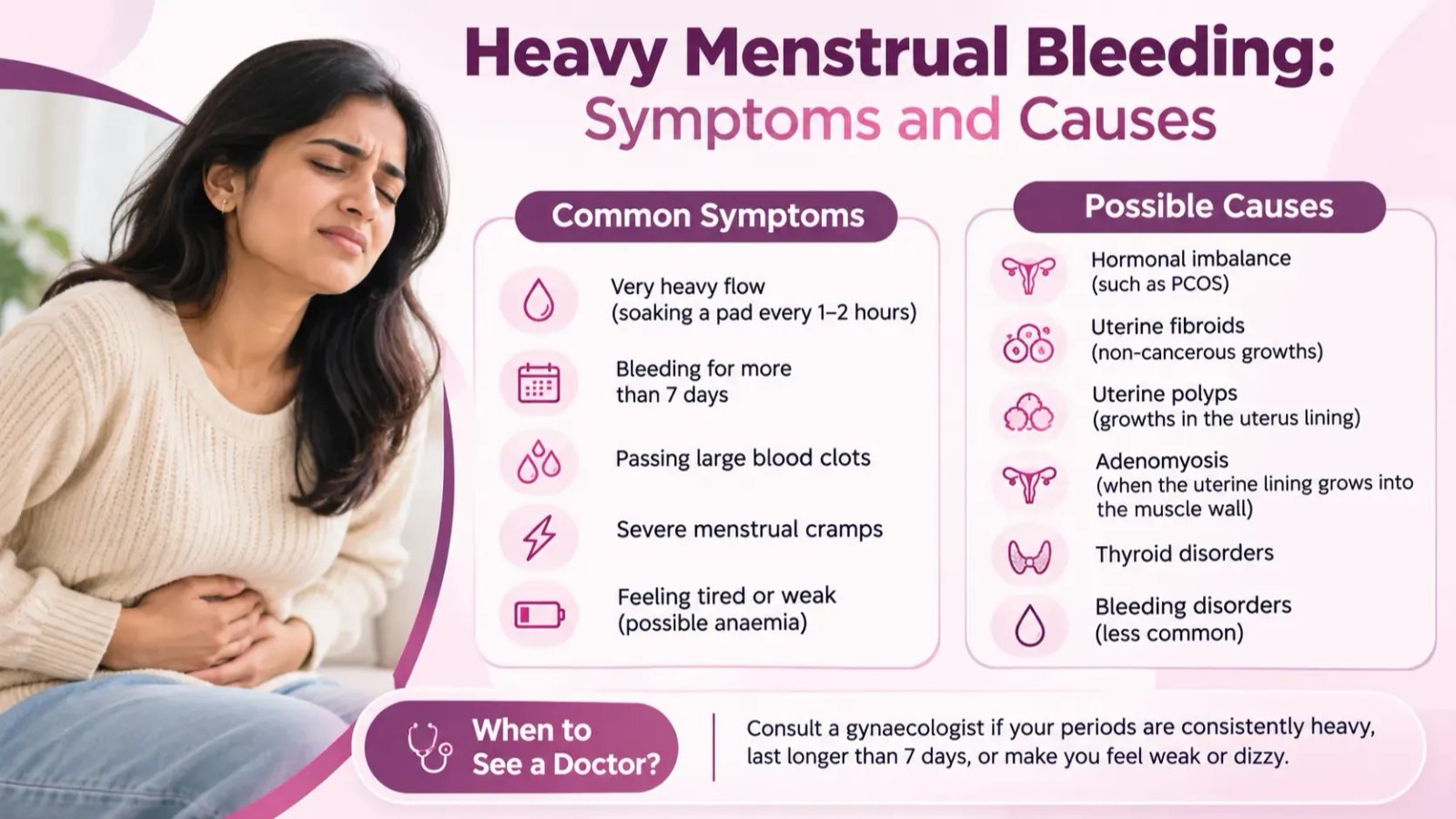
The symptoms of heavy menstrual bleeding can vary depending on the amount of blood leakage and the underlying cause. Common signs include:
- Large blood clots: Passing blood clots larger than 2.5 cm.
- Nighttime bleeding: Waking up to change pads or having pad leak-through while sleeping.
- Severe cramps: Having bad abdominal or pelvic pain during your period
- Prolonged periods: Bleeding that continues for more than seven days.
- Bleeding through clothes: Having your period blood soak through your clothes
- Frequent pad changes: Needing to change sanitary products every one to two hours.
- Disrupted activities: Having to miss work, school, or other activities because of your period.
Signs you are Losing Too Much Blood during your period?
If you are losing too much blood during your period, you may become anemic. Look out for these signs:
- Feeling extremely tired or weak.
- Dizzy spells.
- Breathlessness.
- Pale skin and feeling weak.
- Fast heart rate.
- Fainting spells.
You should see the doctor if you have to change your pad every hour for several hours in a row. Go to the ER if you have very heavy periods and you also have fainting spells, dizzy spells, chest pain, or shortness of breath.
What Causes Heavy Periods?
Problems with your periods can be caused by different things such as hormonal changes and different conditions of your uterus. Some medications can also cause heavy periods.
1. Hormonal Imbalance
If there is a problem with the balance of your hormones, the lining of your uterus can get too thick, and too much blood can build up, causing heavy and prolonged periods.
2. Uterine Fibroids and Polyps
Uterine fibroids are non-cancerous growths found in the uterus. Women are typically asymptomatic or may have heavy periods. Uterine polyps are growths that are found on the inner lining of the uterus and may cause heavy or irregular periods.
3. Adenomyosis and Endometriosis
Adenomyosis is similar to uterine lining tissue that is found in the uterine muscle wall, which then causes heavy and painful periods. Endometriosis occurs when lining tissue is found outside of the uterus and is associated with painful periods and abnormal bleeding.
4. Polycystic Ovary Syndrome (PCOS)
PCOS is associated with irregular hormonal levels and ovulation. This may result in a thickening of the uterine lining that is then shed during a woman’s period, causing heavy, prolonged periods.
5. Thyroid Disorders
An underactive thyroid can result in irregular periods and heavy, prolonged bleeding.
6. Bleeding Disorders
Disorders such as von Willebrand disease cause heavy, prolonged periods. Women may also experience excessive blood loss during their first several periods.
7. Medications and Contraceptive Devices
Blood-thinning medications or the use of aspirin may increase the risk of heavy menstrual bleeding. Heavy periods may also occur in the first few months after the insertion of a copper IUD.
When to See a Gynaecologist?
It is normal to experience minor changes in a woman’s normal menstrual flow. Heavier, more prolonged bleeding should be evaluated by a gynaecologist. You should see a gynaecologist if you have periods that are longer than seven days.
- Change sanitary pads every 1-2 hours.
- Pass large blood clots.
- Get severe menstrual cramps/pelvic pain.
- Get dizzy, weak, tired or short of breath.
- Bleed between periods/after sex.
Conclusion
Heavy menstrual bleeding should not be ignored, especially when it affects your daily activities or causes weakness and fatigue. It may be associated with conditions such as hormonal imbalances, PCOS, uterine fibroids, or bleeding disorders. Prolonged blood loss can also lead to iron-deficiency anaemia, making it important to identify the underlying cause and seek timely treatment.
If you experience unusually heavy or prolonged periods, consult Dr. Sonu Singh, an Endometriosis Surgeon in Lucknow, for proper evaluation and personalised treatment. Timely medical care can help manage your symptoms, address the underlying condition, and support your overall menstrual health.
Frequently Asked Questions (FAQs)
1. What is the most common reason for heavy periods?
Hormonal imbalances and uterine fibroids are common causes of heavy menstrual bleeding. Other possible causes include uterine polyps, adenomyosis, thyroid disorders, and bleeding disorders. A gynaecologist can help identify the underlying cause.
2. What is the best treatment for heavy menstrual bleeding?
The best treatment depends on the cause, severity of bleeding, age, and whether you wish to have children in the future. Treatment options may include hormonal medications, non-hormonal medicines, or procedures such as hysteroscopy and laparoscopic surgery.
3. At what age are periods the heaviest?
Periods may be heavier during adolescence, when menstrual cycles are still becoming regular, and during perimenopause, when hormone levels fluctuate. However, consistently heavy bleeding at any age should be evaluated by a gynaecologist.
4. When should I worry if my period is too heavy?
You should consult a gynaecologist if you need to change your pad every one to two hours, pass large blood clots, bleed for more than seven days, or experience unusual fatigue, weakness, or dizziness. Seek urgent medical attention if heavy bleeding is accompanied by fainting, chest pain, or shortness of breath.
5. How long is dangerously long for a period?
Menstrual bleeding lasting longer than seven days is considered prolonged and should be evaluated, particularly if the flow is heavy. Very heavy bleeding, especially with dizziness, fainting, or breathlessness, requires urgent medical attention.
6. How can I tell if bleeding is coming from the cervix or uterus?
It can be difficult to distinguish cervical bleeding from uterine bleeding based on symptoms alone. Bleeding after intercourse or between periods may be associated with cervical conditions, while heavy or prolonged menstrual bleeding often originates from the uterus. A gynaecological examination, ultrasound, or other tests may be needed to identify the source.
Related services
Related blogs
About Dr. Sonu Singh
Dr. Sonu Singh is a Senior Consultant Gynaecologist and European-trained Minimal Access Surgeon in Lucknow with over 14+ years of clinical excellence. She completed advanced fellowships in Verona, Italy, and Bordeaux, France, specializing in nerve-sparing endometriosis excision, fertility preservation, and complex gynaecological laparoscopy.
Clinic: Gomti Nagar, LucknowCategories
Browse by clinical specialty